Creating through Characters
Fall 2025
Illustrator and cartoonist Bianca Xunise talks with multidisciplinary artist Rachel Singer and illustrator and world-builder Cam Collins about breathing life into characters, building imaginative worlds, and their experiences in the 3Arts/Bodies of Work Residency Program.
This is a transcript of the closed captions from the video conversation.
Bianca Xunise: Hi, my name is Bianca Xunise. I am an illustrator and cartoonist who makes autobiographical stories about identity and social justice. I'm excited to be here today with two artists, Cam Collins and Rachel Singer, who recently participated in the 3Arts/Bodies of Work residency program. As a fellow alum from that program myself, I'll be leading a conversation with them about their work, their experiences in the residency, and the way they situate themselves within the disability culture community. This conversation is part of a series called the Disability Culture Leadership Initiative, led by 3Arts in partnership with Bodies of Work.
Cam Collins is an illustrator, writer, and creator of "The Way of the Canvas World." Through storytelling and world-building, Cam shares his visual language across many mediums, including painting, album covers, video games, comics, and sculptures.
Rachel Singer is a multidisciplinary artist, teaching artist, and certified occupational therapy assistant. Her work in puppetry, sensory theater, physical theater, ritual, and dance explores the liminal places of barely tangible worlds where memory meets imagination. Thank you both for being a part of this conversation series.
Bianca: To get us started—in your own words, can you each take a moment to describe your art?
Rachel Singer: I have many different forms of art that I do. The art is really centered in connection—connection with the individual I'm creating with, with groups of people I create with, and then also with the audience. Building that relationship and community is at the core. My art is tabletop puppetry, shadow puppetry, and multi-plane puppetry—a form of shadow puppetry where there's a camera that looks down, multiple panes of glass, and I animate different layers of puppets that are then projected on a stage via a livestream camera. The work really starts with dance and embodiment and an exploration of music and my own body to find whatever that starting place is, and then move into a collaborative process with whoever I'm working with.
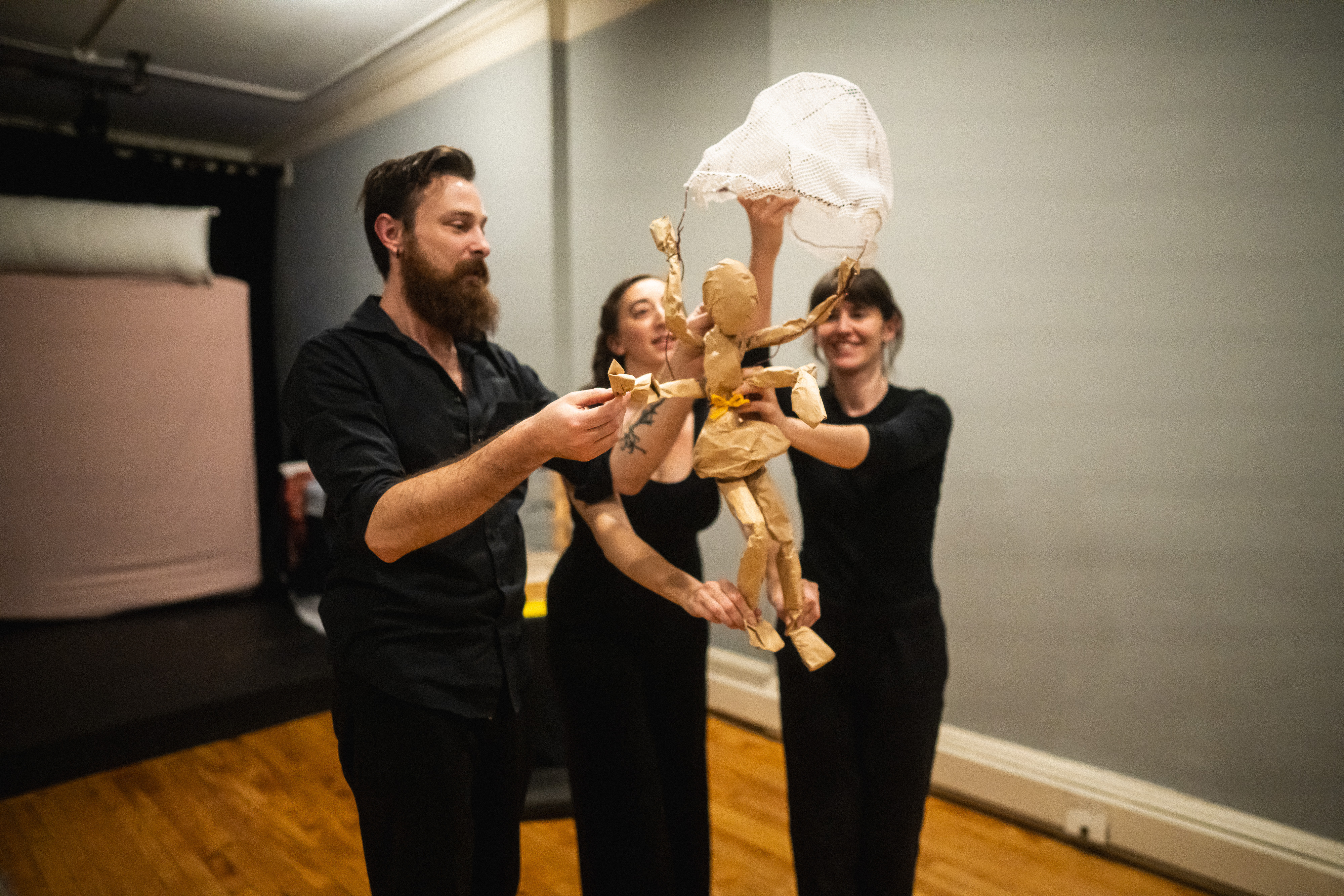 Photo credit: Joe Mazza – brave lux
Bianca: Do you have a dance background that moved into puppetry?
Rachel: A lot of my dance background is in social dance—swing dancing, some salsa—just having that connection. I also did a little bit of Brazilian jiu jitsu. Very different ways of connecting in embodied ways. That sort of led into my connection to puppets. I relate to puppets in a very similar way.
Bianca: And for Cam—I also have Citizen here, who will be filling in for Cam. Can you give me a moment to describe Cam's work?
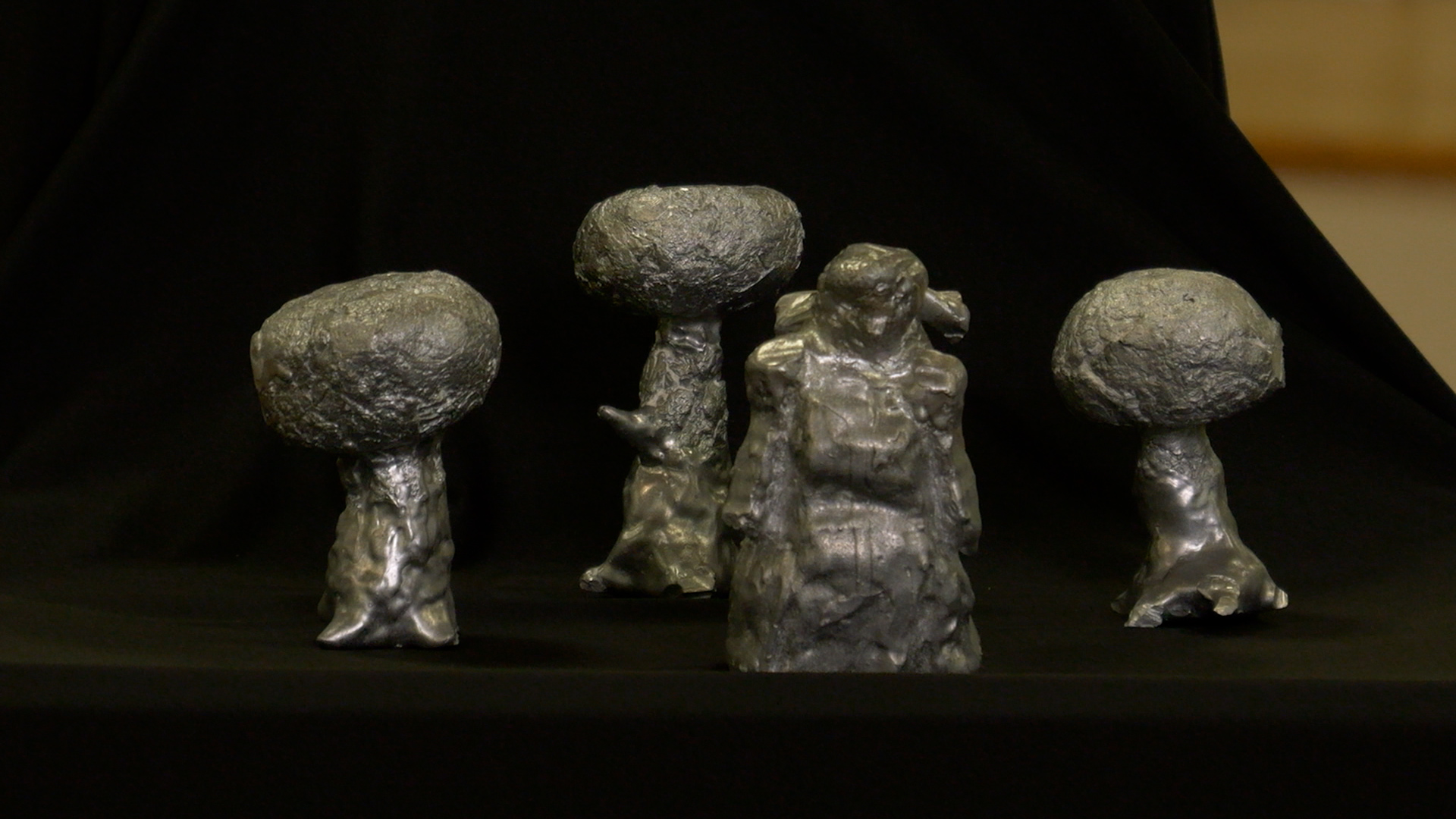 Citizen. Photo credit: studiothread
Cam Collins: I actually have Citizen here because I think in this moment she knows as much about my work as I do. And she has support from the trees behind her—the trees are made of brains. I just wanted to get that out of the way before we start. [Laughter]
I'd say about my work: I really like visual languages, and that's kind of what the world I'm creating—the "Way of the Canvas" world—is about. I like to put stories into different shapes, and by that I do mean literally. My current practice: I draw the shapes that create a robot, like a larger human form in some way, and then I draw stories inside of those. Each story is one whole thing, but within the different shapes it's like separate little nuggets—so when you put them together it's like a whole entire body of work, literally. I was doing this before the whole Bodies of Work thing; it just happened to really fit in. Overview: I like creating worlds and people, and everything they say matters to me. I'm really the only one doing it—I'm okay with collaboration, I love having other people involved—but everything I see is usually part of my own thing. The whole world is not my oyster, but it's an oyster doing the artwork with me.
The whole world is not my oyster, but it's an oyster doing the artwork with me. —Cam Collins
Bianca: I really love that. Both of you are breathing life into these inanimate objects—flat or sometimes three-dimensional—and it's beautiful to see the spark and the way you describe what you do. This is also a great segue because you've both mentioned the Bodies of Work residency. Can you talk a little about what each of you got out of the program?
I got a lot of cry sessions, I'm not gonna lie. [Laughter] I cried a lot—a lot of Zoom tears. I'm an emotional person.
Rachel: I want to take this back to even before I got the residency. In 2013, I met Genevieve Ramos at a 3Arts/Bodies of Work physically integrated dance workshop. At that workshop we met without any words—it was just "partner up next to the person closest to you," sit back to back, and share weight. Our first conversation was actually through dance. As we were dancing I thought, oh my gosh, I really want to collaborate with this artist. So many years later, I was able to invite Genevieve Ramos to be a part of this performance. The performance was about Genevieve and I—our friendship—and going from our ancestors to the present moment, then moving into the future and dreaming of a better future. There's something about needing community to create and to build worlds. Part of that process was having time to build a deeper connection with Genevieve. 3Arts and Bodies of Work really gave us that time to delve into it further.
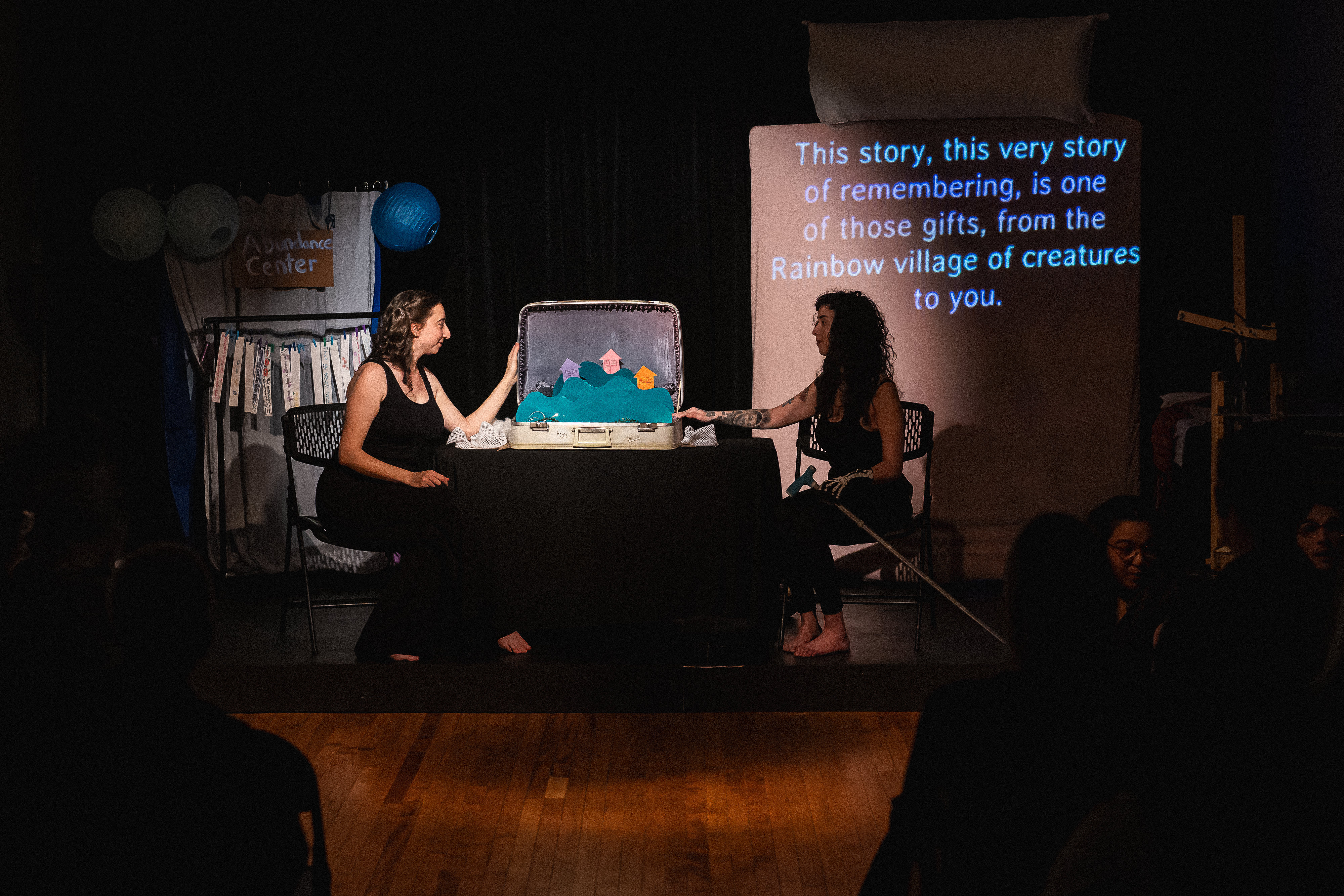 Photo credit: Joe Mazza – brave lux
Bianca: That's beautiful. That's community. That's 3Arts. Citizen, Cam—what was your experience like working with 3Arts?
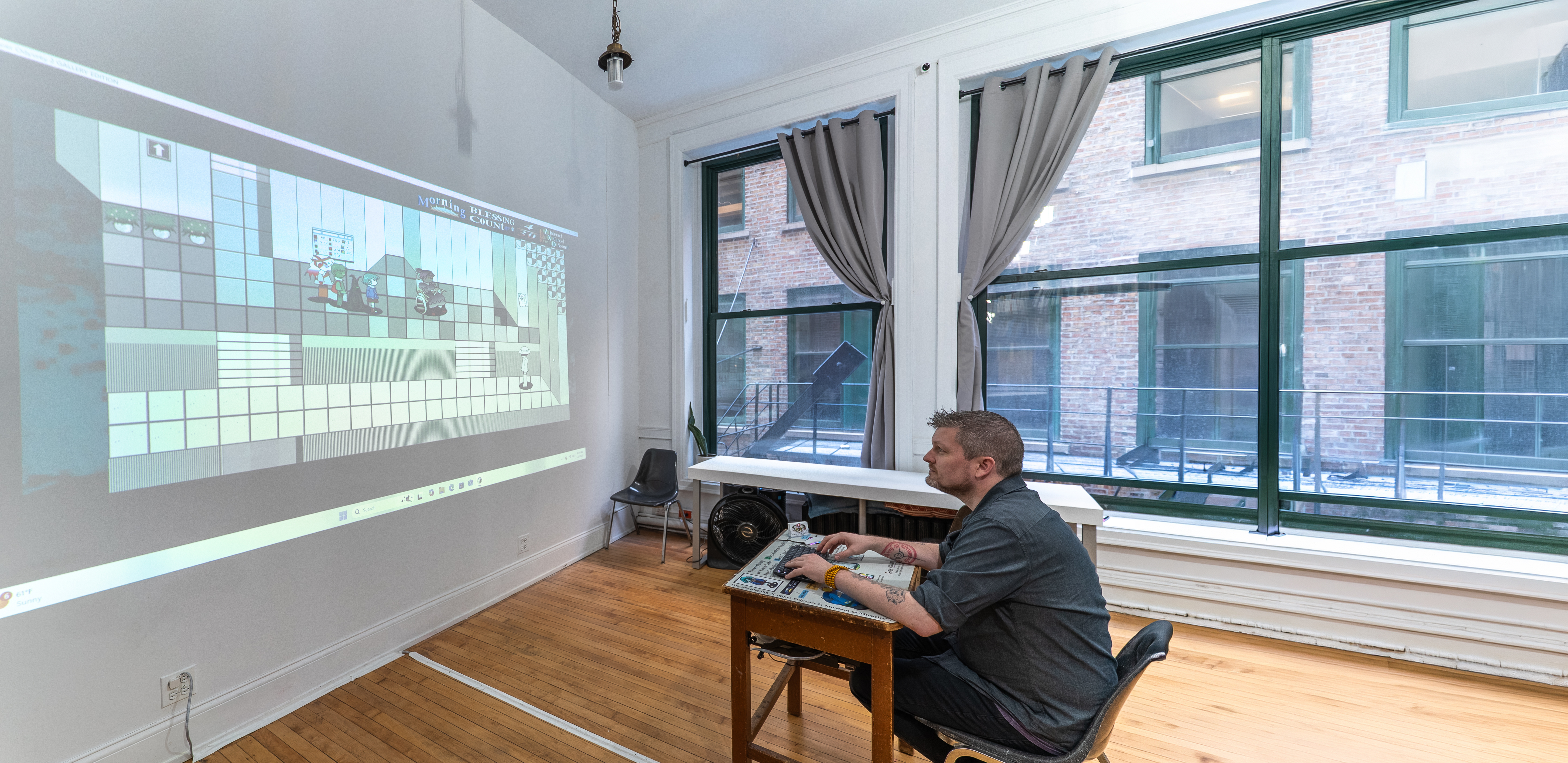
Cam: Really a big deal for me, and really surprising. I never thought I would have a game exhibited in a gallery of all things. A lot of things happen in life that you really want, and they come in a way you'd never really expect. In my case, I made a game called "Copper Odyssey: Museum of Miracles." The main goal—to simplify it a bit—is that you're an angel hired by the curator to bring color back to all the blank white canvases within the museum. Angels have blood basically made out of colors, which is why he hired the angel to do it. In the gallery, the viewer or player tries to find all the blank canvases within the game, touch them, and with each canvas a new painting shows up—each with its own title and story.
For the gallery I had to edit out some of the "monsters"—Citizen can't do quote marks, but me, the real person, I'm doing quote marks behind the scenes [Laughter]—and I brought those monsters into the physical world, plastered on the wall behind the player. And then in the workshop I taught people what I normally do: you draw a set of different shapes that could resemble a disfigured body or some sort of structure, and then within each shape you draw a little story—or different stories. By the time you're finished drawing inside each shape, you have a cohesive story in itself. I only say cohesive because it's all part of the same structure. It's fun, and that's what matters to me. When you look at it you have more stories to look at than just one. And I think that's how life is, right? It's never just one little thing.
Everything's a catalyst. There's always way more.
Bianca: That's beautiful.
Rachel: I love the way you engage with objects—I brought this [laughter] in my pocket; it's just pillow stuffing—but I love that you can endow life into any sort of object, just by looking at it and breathing with it.
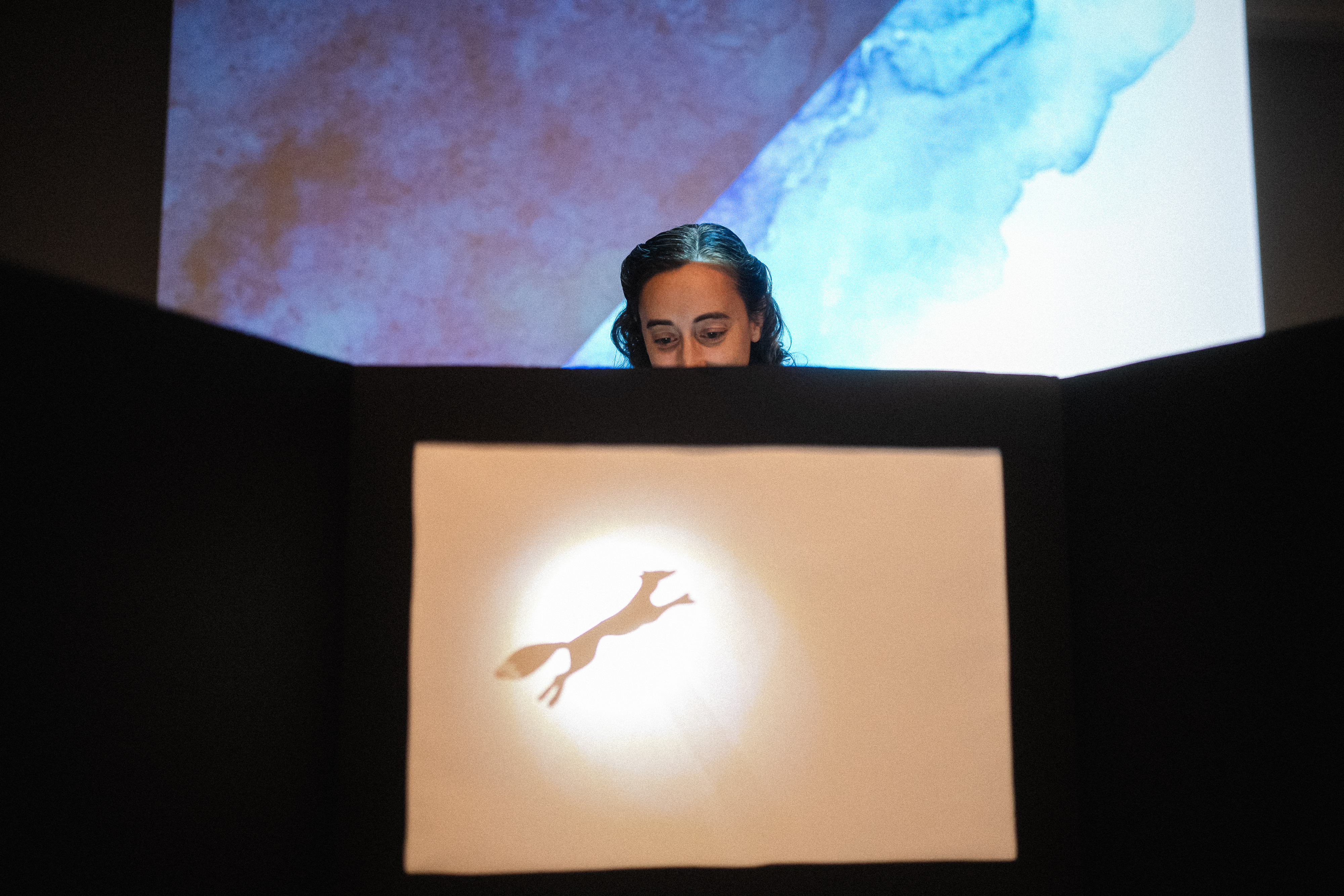 Photo credit: Joe Mazza – brave lux
This is part of sensory theater—investigating what your relationship is, through your senses, to an object. And then giving it to the audience. Handing out things that the audience can engage with and be a part of the experience.
When did I have that moment where I was like, I can breathe life into these inanimate objects? I'm going to grab a puppet so I can share a little. Tabletop puppetry is one of the first forms of puppetry I learned, and this is part of what I did in my workshop for the residency. Just being able to take paper and tape—very simple, doesn't cost a whole lot of money—and endow life into this teeny little object that you just can't help but be like, who is this? Oh my goodness. So this is Papi Lolo—he's Genevieve's grandfather. [Laughter] It's just a practice puppet, but I kind of love the simplicity of it. I use my breath to bring it through my body and into the puppet.
[Deep breathing]
Just breathing, and that stillness, is some of my favorite ways of being. For my workshop I was able to bring together people who would not normally be in the same room—some people who would not be comfortable doing any theater exercises. There was a professor from the occupational therapy department at UIC who said this is not her typical thing, but it felt so comfortable because you're behind this object, working together, in such a collaborative experience—that feeling of anxiety kind of went away and then the puppet just came alive. The people in the room were really what made it such a special experience. Having people from the disability arts world, disability studies, occupational therapy—there's now an occupational therapy student, Grace Irla, who is amazing and has been helping me out with all these different projects. The residency opened up so many doors to creating more workshops—at University of Chicago, UIC, George Washington University. Because of this residency, I had an abundance of space to be in the world of occupational therapy, sensory theater, and puppetry, and merging those worlds together.
Bianca: How do those worlds merge?
Rachel: I think we are all practitioners of being and becoming. When I'm working with OT practitioners, I'm giving them a little bit of space to think about how we can be more creative in our practice and connect more with people—instead of just, here's this thing, take this peg and move it from one hole to another, let's count how many. It's boring, and it doesn't have to be boring. The origins of occupational therapy are rooted in the arts and crafts. I'm trying to take my work as an artist and offer that to the occupational therapy world, and also bring together ideas from disability studies that are often left out in occupational therapy.
We are all practitioners of being and becoming. —Rachel Singer
Bianca: You're both sort of mavericks—bringing puppetry to occupational therapy, bringing video games to a gallery. These games are made by artists; these games are ideas and storytelling. Like the player controlling the puppet. As a disabled artist, what has it meant to be a part of the Chicago disability community, especially through 3Arts?
Cam: Being in stuff like this makes me feel a bit like wanted in the world. There's a group of people who see what I'm making—or even just see me—and they're like, I think what you make and what you want to make would be really good, and it fits in with what other people do. To meet Rachel here, to meet you here too, and even just the prompt of "we think it'd be cool if you and Rachel had a conversation because you're similar"—I've never really had that said to me before. Being able to do this is really awesome. Not just this specific thing, but I really love being part of this group. If it means more community and more people looking at my work and making work with me, that's good. Yeah, it makes me live longer. [Laughter] I love it.
Rachel: There are two things that come up for me. One is thinking about care—and that is the thing we need right now in the world. Disability culture does such an amazing job of finding new ways to show care and build community, and it's not just for the disability community. That is such a profound gift. This container that's been created by 3Arts and Bodies of Work helps us to exist in our fullness. I sometimes think about boundaries as limitations, but often boundaries are exactly what we need for creative process.
The disability community in Chicago has been so caring, and I feel so much connection where often I feel very isolated. People assume that I don't feel isolated, but I have to spend a lot of time by myself and at home resting and caring for myself. The amount of energy it took to create and develop this work was at my edge of what was possible—but because of community I was able to keep going. There were around fifteen people who really helped me throughout this process.
Cam: The myth of loneliness in artmaking is real. I should also name the gallery where I did my stuff—it's the Center for Mad Culture. I went to a few workshops there, just being around a table of people making things, with prompts, with Matt Bodett running the workshops—I really enjoyed that. It's a lot of mentorship and learning. Being able to be someone who feels like they need to learn more—which is always the case, no matter how smart you are—I think is helpful for everyone, in any community, disability or not. It's like, we should always be helping each other this way. I should be honest that I need you as a type of support. It's utopian to think, but: imagine that world. It's hopeful, but it's the hope we need. And it challenges me—I was given this support, this community, this love through this program. How can I now carry it and pay it forward to other artists?
Bianca: Do you two have some questions for each other?
Cam: Do you prefer doing larger puppets or smaller puppets, and why? I saw you did a six-foot puppet at one point. Do you like the bigger puppets because more people can work on them? What's your level of pleasure for puppet size? [Laughter]
Rachel: That's such a good question. I've worked on all sorts of sizes. I worked on a show, "Don Chipotle," many years ago, and one of the puppets was a giant dragon train—fifteen feet—that barely made it out of my apartment. I'm moving more into smaller puppets, lighter puppets, because physically it's difficult. Even holding a large puppet for a long period of time is difficult. It's nice to have light puppets—that's the goal of most puppeteers, a manageable puppet that's not too heavy. I also enjoy the articulation you can have in a smaller puppet versus giant puppets, because giant puppets are just more difficult to make lifelike. But I like them big enough so that three people can be moving them. With shadow puppetry there are multiple people involved—it's still collaborative. Playing with watercolor painting projected, playing with sand projected, having different kinds of materials to work with.
Rachel: I have a question: For your process—when you get that thought seed, how do you think about how you want people to interact with your work?
Cam: Oh god, it's kind of selfish in a way, because I don't really think of all that. [Laughter] I create the characters, and I see it as the characters knowing more about what I want to make than I do. Say I draw a face on a canvas—now the face lives on the paper, so of course they know more about it than me. As I'm drawing, the face can kind of tell me: oh, there's a house there; there's this thing I really like doing over there; I have five or six friends I usually hang out with but only two are with me today. That's just how I view all creation. With games it's more direct—you create a character and the player decides how they move, how much expression they can do. I do think about other people engaging with my work, but it's because of the people I make in the artwork—like Citizen. I'm working for the sake of the characters that don't exist yet, but they do on the surfaces I draw them on. I'm really speaking for them.
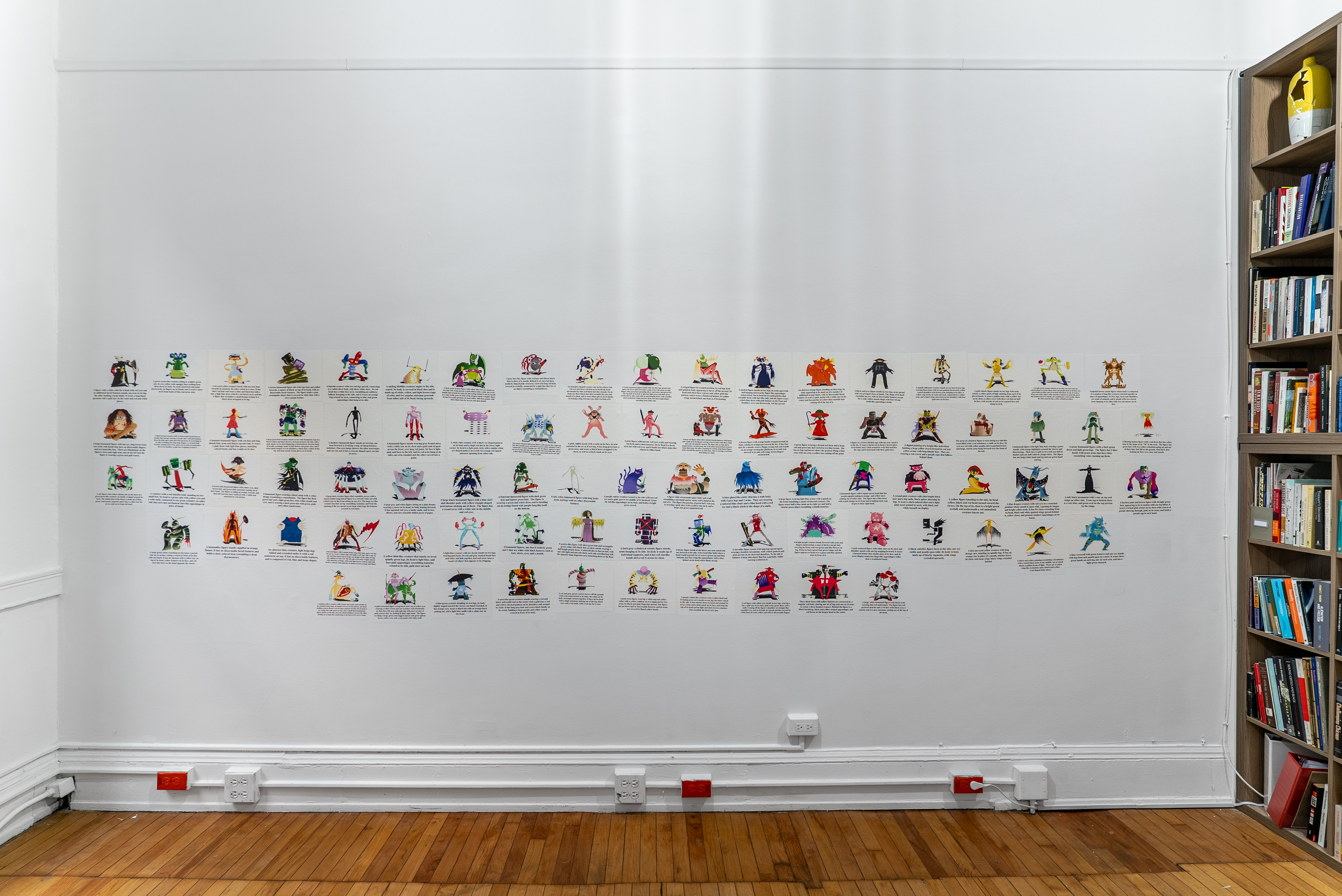 Photo credit: Mikey Mosher
Rachel: I really resonate with that. With the material—you see one thing, you see another thing, and there's this life that emerges just because of how the material is moving in the world. That's how I create some of the characters I work with in puppetry. I have some thought of like, okay, I want this to be a grandfather—but then how does that grandfather move? I never, as the puppeteer, force something to happen, because that's when there's a disconnect of life. Instead it's being like a channel and allowing whatever that is—especially working with three puppeteers, where one puppeteer is not making all the decisions. We're all collaboratively allowing this thing that feels like it becomes its own entity. It makes the decisions authentically, versus in a forced, rigid kind of way.
It's not the puppeteer forcing something to happen—it's being like a channel. —Rachel Singer
Bianca: That's really cool. It's like you're both conduits for your characters—they exist, and you exist to be the mouthpiece of their stories. So what's next? What are you planning, scheming, hopeful for? What do you want to build?
Cam: Right now I'm writing character biographies for all 85 characters in my game. A few people have said they want to know more about the characters—they talk to me but they don't really know them—so I'm indulging in that. It's going to be a big update; I hope to finish it before the end of October. In the future I'm working on another story about a group of students who have to leave a burning building—they can go out through the bottom or the top. That's one thing I'm excited about working on.
Rachel: There's the performance work and then there are the workshops I'm developing. One series is on executive functioning skills, puppetry, and physical theater—how do we practice those skills without framing it in a medical model perspective? Even though this is occupational therapy, it doesn't have to be thinking about "we need to fix you, there's something broken." We're just practitioners of being and becoming, using this as an opportunity to grow and gain skills in a beautiful, imaginative, playful way.
And then I'm working on Eve of a Great Remembering—my show that's been a work in progress for a while and is turning into a series. I want to bring people into places of remembering. With Genevieve and I, we went into those places—remembering our ancestors, like me remembering my ancestor who was a scribe, and Genevieve remembering her grandfather who was an artist. This interview process I did with Genevieve and her family was so powerful. I'm very curious to see: can I get a group—maybe multiple groups—of artists together to be in this interview process of asking someone, what memory do you want to bring into the world? And having artists support them in bringing that into the world—musicians, puppeteers, physical theater, dance—any constellation of artists that somebody wants to work with, to bring their sacred memory or remembering into the world. That is part of the healing I see as necessary—building connection and listening to each other's stories.
What memory do you want to bring into the world? —Rachel Singer
Bianca: Yes!
Rachel:Understanding what is this to you, what does this mean. Just sitting with Genevieve and understanding her better, asking so many questions—even though you knew each other for so long—gave you this beautiful insight. I want to see that. That sounds incredible.
Bianca: Both of your stories are so much about the transformative process of experiencing. A lot of arts and social stories are often traumatic, and we carry that trauma generationally—and we transform and see: how can we make it better? How do we process it through our art?
Cam: Yeah, the art speaks to it.
Bianca: It's so cool to be alive right now and to see the type of work being made through Bodies of Work, through 3Arts, in Chicago. Best city in the world!
Cam: Coolest artists in the world.
Bianca: [Laughter] Where can people find you after this?
Rachel: You can find me on Instagram at @practiceofimagination.
Cam: You can find me on Instagram at @collins_cameron. I also have a website: camcollins.us. You can find all of my games on Steam and itch.io—look up "Copper Odyssey."
Bianca:Thank you to 3Arts for having us and giving us this opportunity to have this conversation. I'm excited to see what story it is you all tell in the future. Because that's how we're gonna keep it alive.
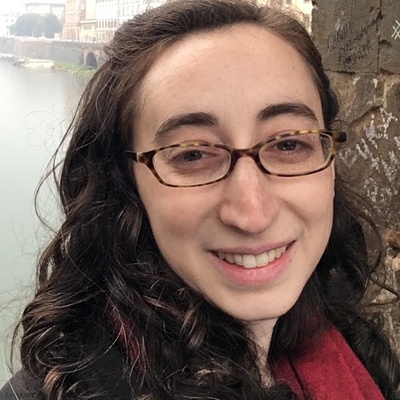 Rachel Singer
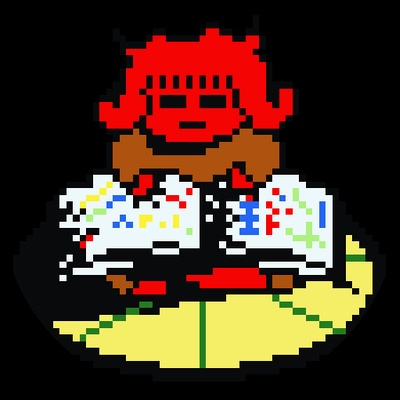 Cam Collins
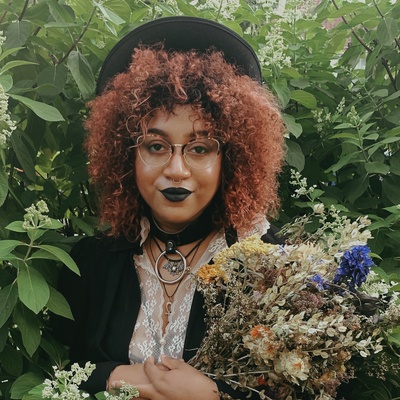 Bianca Xunise

The Disability Culture Leadership Initiative and 3Arts/Bodies of Work Residency Program are supported in part by grants from
the Joyce Foundation and the National Endowment for the Arts.