Permission to Re-discover Self and Practice
Fall 2025
Playwright and citizen artist Tsehaye Geralyn Hébert talks with visual artist Lillian Heredia and actor and multidisciplinary artist Terri Lynne Hudson about reinventing belief systems, the generative possibilities of chronic pain, and what it means to give yourself permission to make the work you actually need to make.
This is a transcript of the closed captions from the video conversation.
Tsehaye Géralyn Hébert: Hi, my name is Tsehaye Hébert. I'm a citizen playwright committed to inclusivity and sustainability. Through my work I bring communities and different demographics together—sometimes to grieve, sometimes to heal, to celebrate, and to move boldly forward, whatever that means. I'm so excited to be here today with two artists, Lillian Heredia and Terri Lynne Hudson, who both recently participated in the 3Arts/Bodies of Work residency program. As a fellow alum from that program myself, I'll be leading a conversation with them about their work, their experiences in the residency, and the ways they situate themselves within the disability culture community. This conversation is part of a series called the Disability Culture Leadership Initiative, led by 3Arts in partnership with Bodies of Work.
Special thanks to the Mayor's Office for People with Disabilities, including Commissioner Rachel Arfa, and the Central West Community Center here in Chicago, which is one of the outposts operated by the Mayor's Office and where we're filming today.
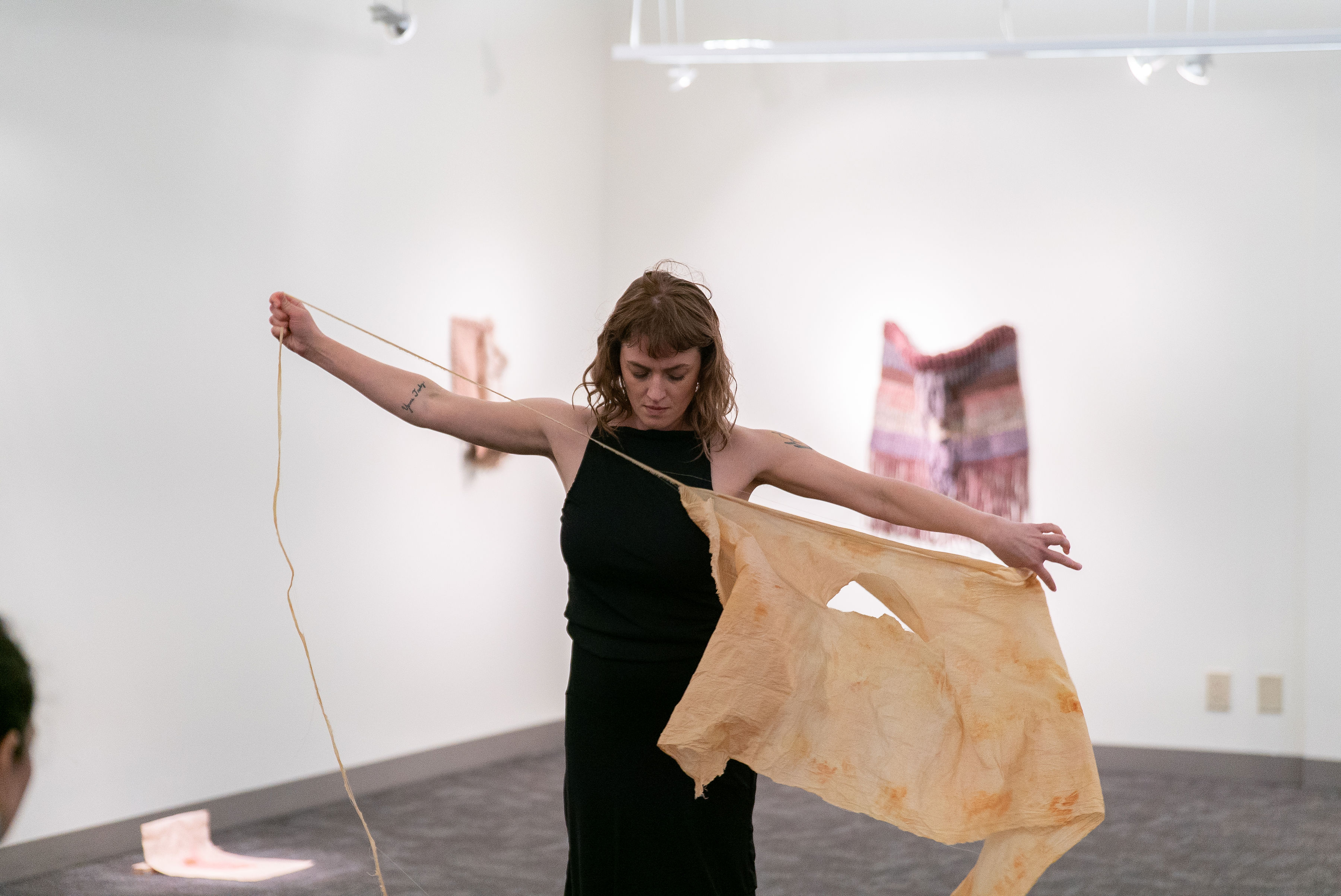 Photo Credit: Mikey Mosher
Lillian Heredia is a visual artist whose work grapples with past experiences with religion, sustenance farming, chronic pain, and motherhood through the lens of her background in biology.
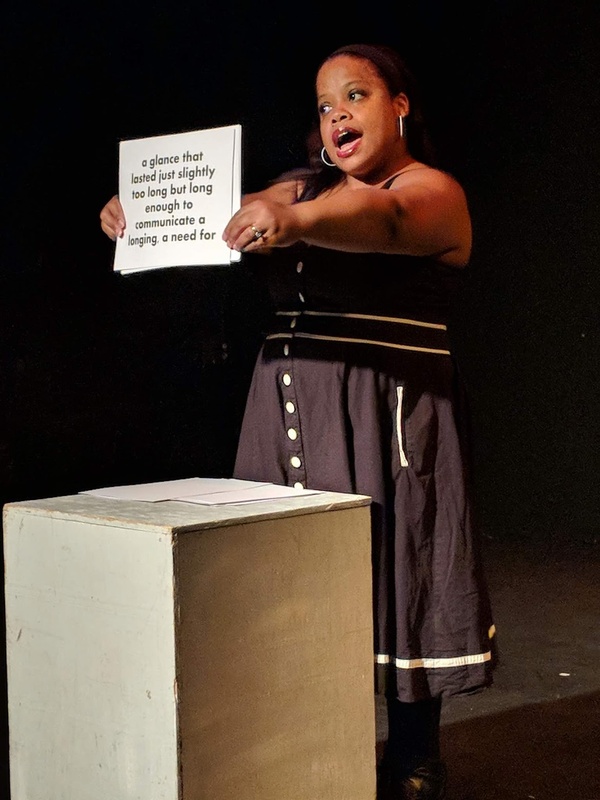 Container Store Play. Photo Credit: Cassandra Rose
Terri Lynne Hudson, joining us virtually today, is an actor, a multidisciplinary artist, and disability rights advocate. Her work highlights the generative and inclusive art that emerges when disabled and chronically ill artists are centered and supported. Thank you both for being with us today and for being part of the series.
Tsehaye: Terri, to get us started—in your own words, can you describe your art?
Terri Lynne Hudson: Well, I'm a performer—that's the big overall umbrella for me. I perform in a lot of different mediums and in a lot of different ways, but at the beginning and the end I am always a performer. And I perform because I have a need to tell stories—stories that don't usually get told, or stories that don't usually get told through someone who looks like me and moves through the world like me.
Tsehaye: How about you, Lillian?
Lillian Heredia: I make physical objects most of the time. I do a bit of performance as well, but more like gesture-based performances. My objects are typically constructed with found material or more traditional sculptural materials such as wood, wax, or plaster. I make work about my experiences with a radical Catholic upbringing in conjunction with sustenance farming, in conjunction with my experience with pain and the medicalization of that. It's sort of like a matrix where all of those things overlap for me, and then I kind of search for ways that they mirror one another.
Tsehaye: That's a complex bit of gumbo. [Laughter] As is everyone's life and experiences. Can you talk a little bit about what drives your creativity? What gets you up in the morning, what keeps you up at night? For both of you—where do you just go down that path and you're gonna do it until? [Laughter] Terri, you want to lead us out?
Terri: Sure, absolutely. For me it is a combination of two giant driving forces. One of those is spite. And the other one—that is not spite—is that a lot of stuff is happening in my head and I really desperately need to show it to other people. So those are the two things: spite, and getting the things out of my head into the world because they have got to go somewhere. [Laughter]
Tsehaye: And I might add, with a sense of humor. I'm hearing it, I'm feeling it, I'm sensing it. [Laughter] You know I love that spite was reason number one.
Lillian: Creatively I'm driven by re-inventing a personal belief system or world view. I mentioned briefly that I'm coming from a background that's very conservative and very rigid, and I really only broke from that a little bit later in life. Art for me has been part of that transformation, but it's also been: how do I create new origin stories? How do I reinvent myself and understand what I believe in and what I'm interested in—and how do I discover it for myself but then share it with anybody else who's interested?
Tsehaye: As an extension of that question—can you talk about some of the materials you use and how that speaks to your need to address what drives you and moves you in the direction you're called?
Lillian: I like to say that I have a lot of things in my studio that aren't art until they're art. The materials I work with—if they are traditional sculptural materials like wax, plaster, or sometimes wood that I steam bend—there is this sort of need for them to go through a phase change. Wax is liquid and then it hardens into whatever form you can coax out of it. Plaster is the same—it goes through a reaction and then becomes what it's going to be based on how you molded it. Steam bending wood is sort of the same thing. So I think it's more like an obsession with that phase change, about transforming something into something else.
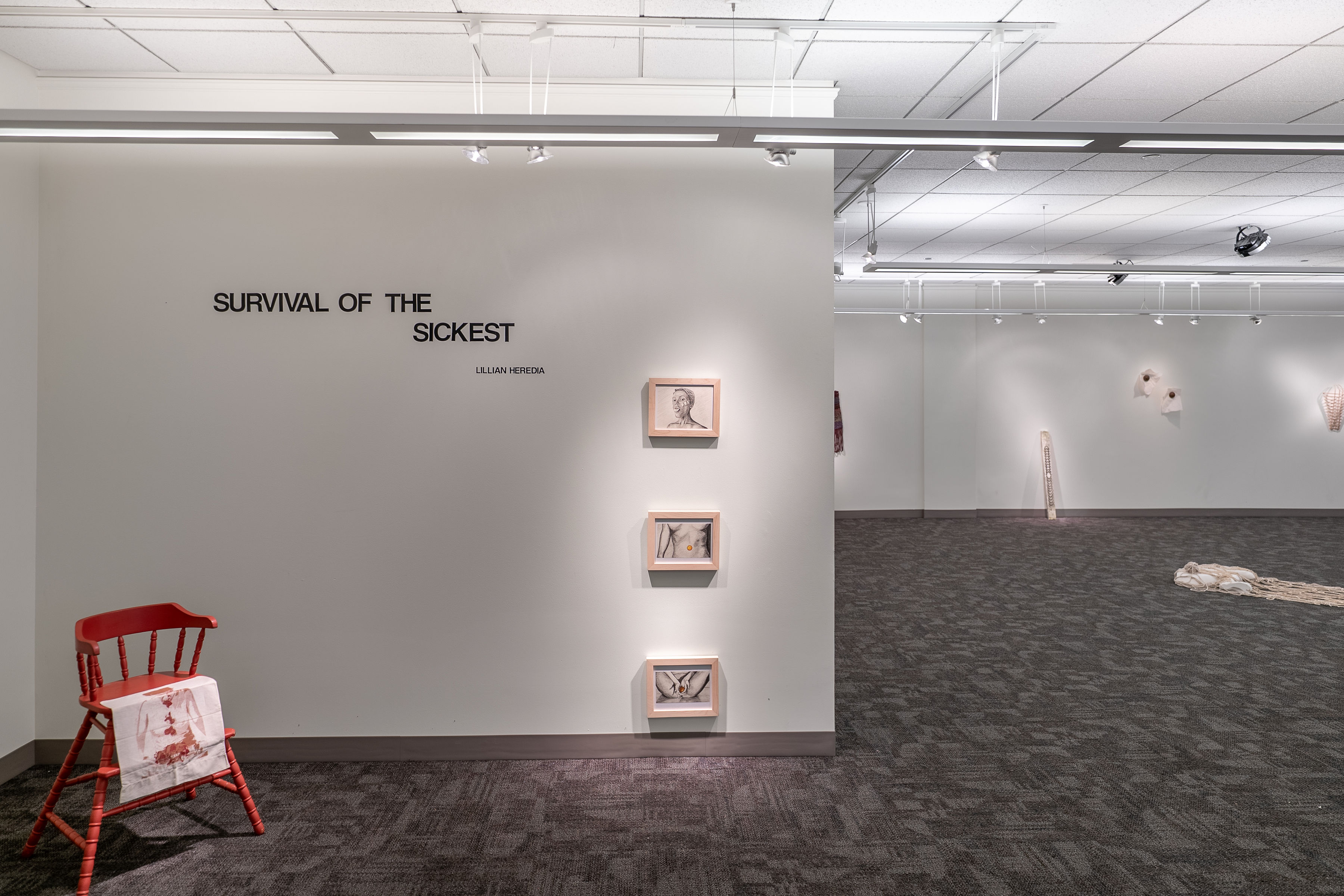 Survival of the Sickest
And then the pull toward the found object—it's a little bit like a fascination with biological material. I am genuinely fascinated with anatomy and physiology, not just human but animal and plant. I think we all have these universal universes within us that are endlessly beautiful. Pulling those materials into my work just feels like that's already a brushstroke—it's already doing something lovely as it exists in the world. Making something natural do something kind of unnatural is sometimes an interesting thing for me.
I have a lot of things in my studio that aren't art until they're art. —Lillian Heredia
Tsehaye: Terri, talk with us about what some of the raw materials are that you're working with. You talked a little bit about the story and the spite and...and spices, I will add as well.
Terri: For me there's the fact that I grew up nearly isolated, and that made me really very strange. It's an experience that's unique in some ways but almost archetypal in others. I grew up being a voracious reader and having nearly unlimited screen time—and I could do both because I also nearly never slept. So if you put all of those things together and you have this small child who is not independently mobile and who is constantly taking in media and constantly thinking about it and constantly awake, you get this cocktail of someone who is just sort of chewing on all of these images and archetypes and bits of pop culture and quotes and stories and reimaginings and retellings of all of these different stories and thinking: if I were to tell this story, how would it be different? If I were to tell this story through the viewpoint of one of these characters that's been with me my whole life—when I didn't have peers I was spending time with, I just had my books and my television and often my imagination on these adventures with fictional characters—what was my perspective of that?
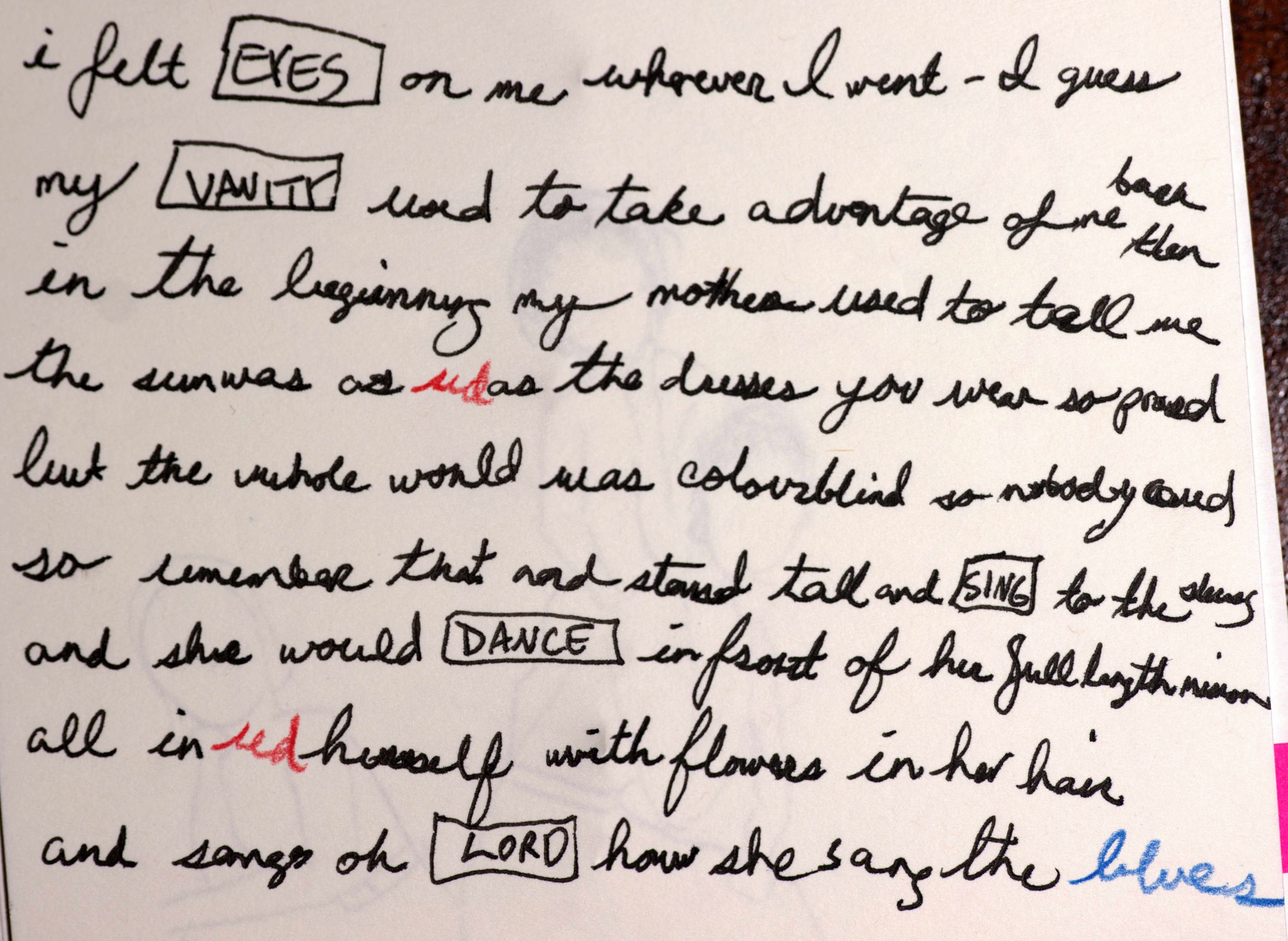 Photo Credit: Charles Duffy
And that is kind of what I bring to all of the sorts of storytelling and bringing characters to life that I do. I see acting as storytelling—you're inhabiting this character and this character is inhabiting you, and you are telling their story on your stage or in front of a camera. That's what drives me: this cocktail of input in my head that turns into output when I create a story, whether I'm doing traditional storytelling, casting a role and acting, or whether I've written something—which I honestly don't even really like doing—and I'm performing it.
Tsehaye: I'd like to underscore that both of you talked about reinventing and reimagining. It really feels like in your hands this is a real, dynamic process happening all the time, whether it's in the studio, in the gallery, or here. There just seems to be lots of movement and thinking and shaping of your work. Speaking of that, I'd like to move to questions about your residency. Could you talk a little bit about your aesthetics, what you learned, what was shaped differently for you through the time you had to devote through the residency?
Lillian: My residency culminated in an exhibition at Access Living here in Chicago. The residency gave me a framework to think about my experience with chronic pain that I had before relegated to this boundary where—you know, I don't talk about that, or I'm avoiding that, or eventually that'll go away and I won't have to think about it anymore. And I'm at a point in my life where I can't ignore it anymore. I spent a lot of time looking back and realizing: oh yes, that piece wasn't just about the extractive nature of motherhood—it was actually kind of about my contentious relationship with my body.
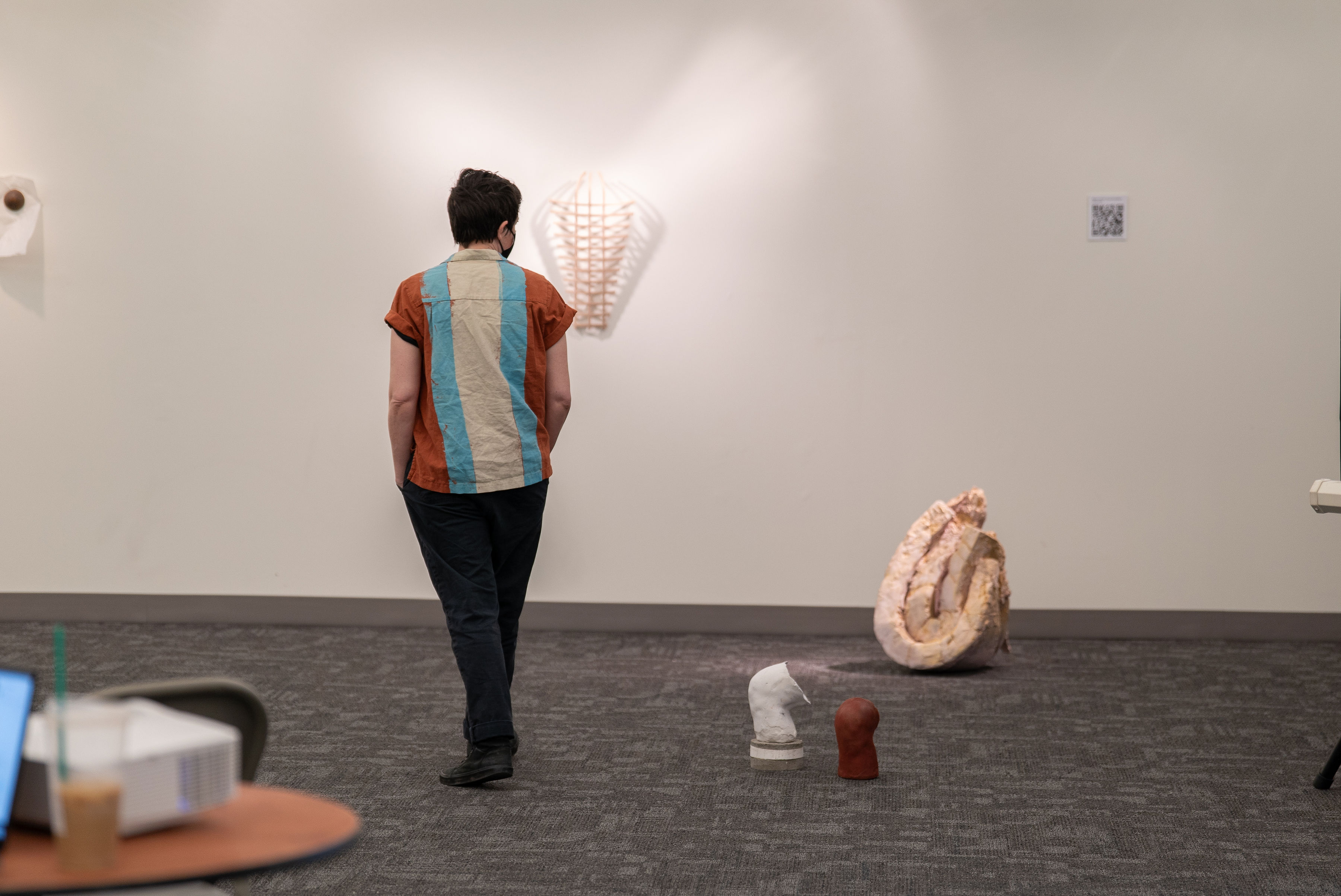 Photo Credit: Mikey Mosher
More than anything, the residency gave me language around what I was doing, and it also introduced me to ways of thinking about the experience in my body that could be generative instead of dismissive. The final exhibition incorporated some older works that I was reimagining for the first time through the disability lens, but then I actually generated quite a few new works. It kind of felt like a story—like I was putting a story together that paid homage to what I was doing in the past that I didn't realize was coming from this place, and then looked forward toward what else I can make from where my body is at and where it's probably headed.
The residency gave me language around what I was doing—and ways of thinking about the experience in my body that could be generative instead of dismissive. —Lillian Heredia
Tsehaye: Speaking of that, I wanted to bring the conversation to you, Terri. Your relationship with your art forms started earlier—they're rooted differently. Coming into the residency, can you talk about what you learned, what expanded for you?
Terri: I'm definitely going to grab that word permission, because I definitely feel like this residency gave me a lot of permission that I didn't feel like I had been able to give myself or get from other institutions in the past. It was very freeing and very opening. My project ended up being very ambitious. When I applied I was like, well, I'm an actor and there's a pandemic and I am medically vulnerable slash chronically ill, so I'm not out doing plays anymore—I don't know what I'm going to do if I get this. I guess I just have to write a one-person show and do it, because that's what one would expect if I'm doing theater.
But when I met with my mentor I really felt like I got this permission to: you can kind of do whatever you want to do. This is your time, this is your space, just do something. And so I kind of tried to do all the things [Laughter] in two and a half months. It was very ambitious. Thankfully I have technical support at home from my spouse who is an engineer, because I was like, well, I don't want to be anywhere in person—I'm going to draw a hard boundary line there—but we have the technology so we're going to stream something.
When I was told about having collaborators, I immediately reached out to other disabled artists I've known in my life with some other overlapping marginalized identities, who don't live here. I was working with someone from Texas, someone in Sweden, and someone I thought was here who ended up being in a different state altogether. [Laughter] And we all got to create things together. I made this show—a sort of collage of all of those things—and I also felt free to work in media I wasn't necessarily that familiar with but was interested in, but had always felt like I was put in this box: no, this is not what you're good at, you need to stick with the thing you're good at. And I was like, well if I tried, maybe I could be good at this, or maybe I'm better at this than I think I am. So my work actually ended up having visual art in it, and original music, and all of these different components because I really got this feeling of: why not? Why can't I? I don't feel like I'm hearing that I can't or that I shouldn't, so I'm going to. And here it is.
I really felt like I got this permission to: you can kind of do whatever you want to do. This is your time, this is your space, just do something. —Terri Lynne Hudson
Lillian: Oh, absolutely—I would have to concur, that's kind of what it felt like for me as well. For me, a big aha moment which I kind of just realized as you were speaking was that typically in my process I'm doing a lot of research, a lot of reading, taking in a lot of things, and then I produce something and I kind of understand why I made it. In this residency it was like a reverse-engineer kind of process—it was like, oh, that's why I made that! It was kind of impossible for me to think that anybody had considered those things in the same way that I had, just because it had been so inaccessible to me. So there was a reverse-engineering to my typical process.
Tsehaye: When I look at your work I also saw different forms—just each piece looks very different, but I understand the collection. I wanted to speak a little bit more about form, and then Terri I want to come back and ask you the same thing. Lillian, does the form choose you?
Lillian: I think sometimes the form comes out of the raw material or the found object I'm working with—like I want to just duplicate that. For example, there's a piece I made with a mold I made from communion wafers, and it was really important to me that it look the same as a communion wafer does. But then there are others that seem to reference something microscopic—an inner tissue or inner organ—but then they're outrageously magnified in real space. So I think sometimes it comes from the found object, and then other times I'm thinking a little bit about zooming in and zooming out.
My experience with chronic pain and this condition that I'm constantly revisiting in my life—there's a little bit of the outside and the inside coming out, and how that manifests in the studio. How the experience of chronic pain kind of dismantles predictability in terms of scale or duration. During the residency I really tried to lean into that.
Tsehaye: Terri, talk about the forms your work is now taking and what that means for you.
Terri: Right now my work is going in a lot of very interesting directions. One thing that happened during the beginning of the pandemic is I was transitioning to remote work, and then when remote theater dried up I started getting into audio narration. So an awful lot of what I do right now is narrating other people's stories, but I'm bringing myself as the storyteller to all of those stories. Storytelling was very much in my mind when I started working on my 3Arts work, and so I created this character who was going to be telling some stories. I wanted to work within things that I had written or that were in the public domain, so I started looking at traditional folk and fairy tales—which are things I've always been really fascinated with, especially as you grow up and find out that we've been fed a lot of sanitized stories that started out a lot darker. I like exploring that darkness. I am a big horror junkie, so everything is like: what is the horror movie retelling of this? [Laughter] That's just kind of how I roll through the world.
So I made this character who was sort of a princess in a tower. The princess was staying in this tower because outside is the plague. And everything that happened within the world of my performance was either the princess journaling and reading stories from her journal, or dreaming—and in her dream she explores the outside world, because in her dreams it's safe-ish. Because in fairytale land things aren't always safe and you never know when they're going to get unsafe. And so I brought some of that stuff that had been cooking in my head since I was honestly a small child into the world, and that was my material.
Tsehaye: We have a few more questions, but we did want to ask a bit about some of the challenges you're facing. What does it mean to be a member of this community?
Lillian: I'm embarking on a new career because I've been living without health insurance for a few years, which is unacceptable and unsustainable. Challenging-wise, graduating from art school and somehow carving out an existence where at the end of the day I still was struggling to pay my mortgage—that kind of financial stability stuff is challenging. And then explicitly making work from the place of acknowledging a limitation, or an experience that is not always pleasant for me—there's a little bit of that being a weighty, heavy thing. Making work from that place is not always buoyant and joyful. It's kind of necessary, but it requires a little bit more time on the backside to process and work through. I make work about a lot of heavy stuff, so they all sort of take their toll. I think it would probably be those two things: the very practical things that our world does not make space for in creative practitioners, and that in itself is very difficult, and then making work about things that are hard to talk about and hard to process.
Tsehaye: Terri, what are some of the challenges you are facing right now with your work?
Terri: I mean, we have the fact that I am a chronically ill, medically vulnerable actor during a pandemic that people are in denial about being a pandemic. So there's not a lot of work for me out in the world, and there's constantly negotiating with people who approach me wanting to do things—I'm like, okay, what are your COVID precautions? And if you don't have any I can't work with you. Is there a way I can participate remotely? Can we make a way I can participate remotely?
It's really interesting seeing where people have all of these boundaries about how they can do live performance and who has to be physically in the space and who doesn't—and why? And why not? I understand that some of that is complicated when you get into the unions, and the fact that we have had AI and people's images stolen and so they've got a sort of blocker on using virtual and recorded stuff because they're worried about it being used against them. But there's also the fact that as a mobility-impaired stage actor primarily, there were only about a quarter to a third of the stages in Chicago that I ever had access to before the pandemic. The fact that there are so few spaces where disabled actors can work, and that we don't have the same access to opportunities and don't have the same ways to climb the ladders—and there's another access joke there—that non-disabled actors have access to. And I'm like, somebody needs to do something about that. We now have all of these tools where we can bring people into spaces that are not necessarily accessible, so why are you telling me we can't even do that? It sounds to me like you're committed to ableism and we're trying to get you to be committed to access.
So with my performance, a thing that I was also trying to say was: I'm doing all of this from my living room. And why can't we have more of this? How do we make space for maybe someone's voice to be in a space that their body can't be in? Or to have some people physically in the space, but can somebody be pre-recorded, can somebody be streamed in—can we explore those things instead of just going back to normal? Because normal was fine—when no, normal was not fine for an awful lot of people.
Normal was not fine for an awful lot of people. —Terri Lynne Hudson
Lillian: That actually leads me to the question I was sort of formulating for Terri. I find it so interesting that theater is your medium, given that I see those spaces being excessively inaccessible—especially as a performer. I'm curious: was it that you didn't really have any choice, like that was the thing and you just had to do it? Or is this part of the spite thing, where you were like, you say I can't be there, I'm going to be there?
And then part B: when you are taking on a role and telling a story, do you feel like you're embodying who you are as a disabled artist even more so, or do you feel like you're temporarily transported out of it?
Terri: With wanting to be an actor—I started wanting to be an actor when I was about eight years old, and I don't think I understood the physical rigor. When you go to see a play you're often just in the dark with a spotlight on the stage, and there's people sitting at a table or standing there maybe doing a little bit of walking back and forth. You don't see the whole precarious backstage. You don't see the three flights of stairs up to the rehearsal room. Where I was encouraged to watch a lot of theater as a kid, I didn't get to perform until I was an adult—I just wasn't indulged in that way. And I don't know if it's because the adults in my life feared accessibility, or honestly if they just thought it was silly and a waste of time and I should focus on other things, because I was very much pushed toward hard academia growing up.
So yeah, a lot of it was ignorance more than spite at that point. I just saw the thing and wanted to do the thing, and did not realize everything that the thing entailed until I was 18, 19 years old, going to auditions, and going: oh, this is up three flights of stairs. Well, I've got to make a decision right now as to whether or not I'm going to go up these flights of stairs and commit to going up these flights of stairs for the next 8 to 12 weeks. And I spent a lot of my early career honestly harming my body trying to pretend I wasn't disabled to people, because I also thought I wouldn't get hired if people realized I was disabled. I didn't know there was a disability performance community until way later. I wish I'd found it earlier.
Tsehaye: We have one more question, and then I think we're about wrapping it up. I would really like to ask my question. [Laughter] So Lillian, I'm really interested in the fact that you came into art later, after doing a more you know sensible, practical career path. I'm kind of wondering—what was the spark? What did that for you? Why art then? Why art now?
Lillian: Yeah. I think I always had that within me, but I ignored it and I denied it because it wasn't practical and it was not supported, and I had nobody in my life that was mirroring that—showing me how to do that. It's interesting, I go around and I meet people and I realize we're all coming from really unique backgrounds, but the journey from there to here necessitated like a total breakdown of beliefs, families, structures. I watch and I'm also really into learning about cults, because I wouldn't call what I came from a cult—but like, pretty close. So it really meant burning everything down and then making everything from scratch, and art being the only thing that made sense.
I talked a little bit about origin stories—it was like I'm trying to reinvent personhood, and reinvent a belief system and a world view. And that's not easy, but it's getting easier. Especially with opportunities like this where I'm constantly being introduced to a new community that I felt I had no knowledge of, or was afraid of—and then the veil being lifted and realizing, oh, this is also available to me. That's the reason for later in life. I wish I'd done it a lot sooner, but at least I did it.
Terri: You're here now.
Lillian: Yeah! [Laughter]
Tsehaye: What an honor it is to speak with both of you. What an incredible time it is for us as artists—that we are able to not only make art but to be able to talk about art with each other. Sometimes we're in the making, making, making—and to be able to have some reflection and really savor what it means for us at this time is pretty remarkable. Thank you both for your art, and for bringing some compelling ideas to the table.
Terri: Thank you. You too!
Lillian: Thank you, both of you.
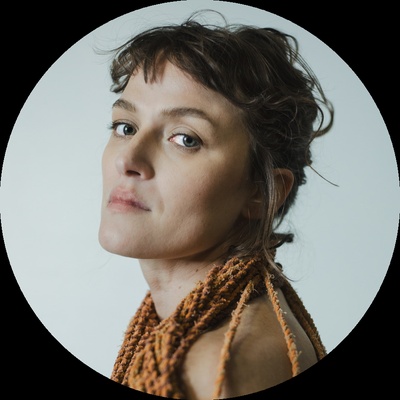 Lillian Heredia
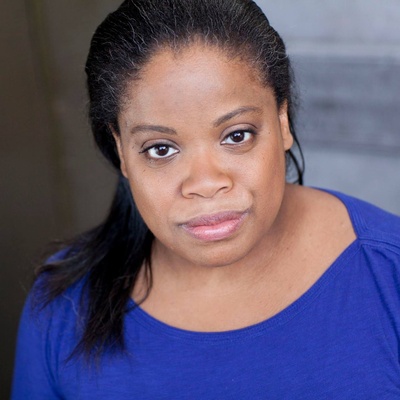 Terri Lynne Hudson
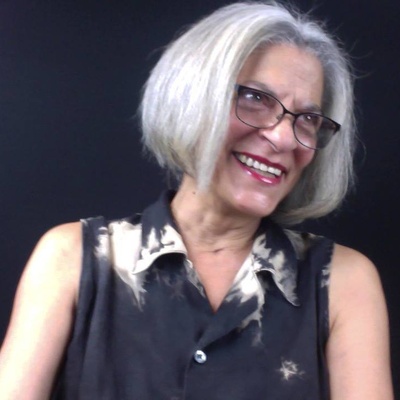 Tsehaye Géralyn Hébert

The Disability Culture Leadership Initiative and 3Arts/Bodies of Work Residency Program are supported in part by grants from
the Joyce Foundation and the National Endowment for the Arts.